Is your business growing❓ This article highlights how you grow from a busy business to a scalable business 📊
Chidi has been in business for seven years.
He opens at 7am and closes at 9pm. He has not taken a full week off since 2019. His phone rings before he gets out of bed and the last thing he checks before sleeping is his WhatsApp, managers, suppliers, customers, all of them waiting for him. By every visible measure, Chidi is a serious businessman. His shop is always busy. His staff are always moving. His revenue has not grown in three years.
Across town, Amaka started her business four years ago, three years after Chidi. She works fewer hours. She takes her children to school on Fridays. She travels twice a year. Her revenue has grown 40% in the last 18 months. She is about to open her third branch.
Same city. Same market. Same economy. Completely different trajectories. The difference is not hustle. It is not luck. It is not even funding. It is the system behind the business and specifically, how each of them manages the engine that drives everything: their operations and inventory.
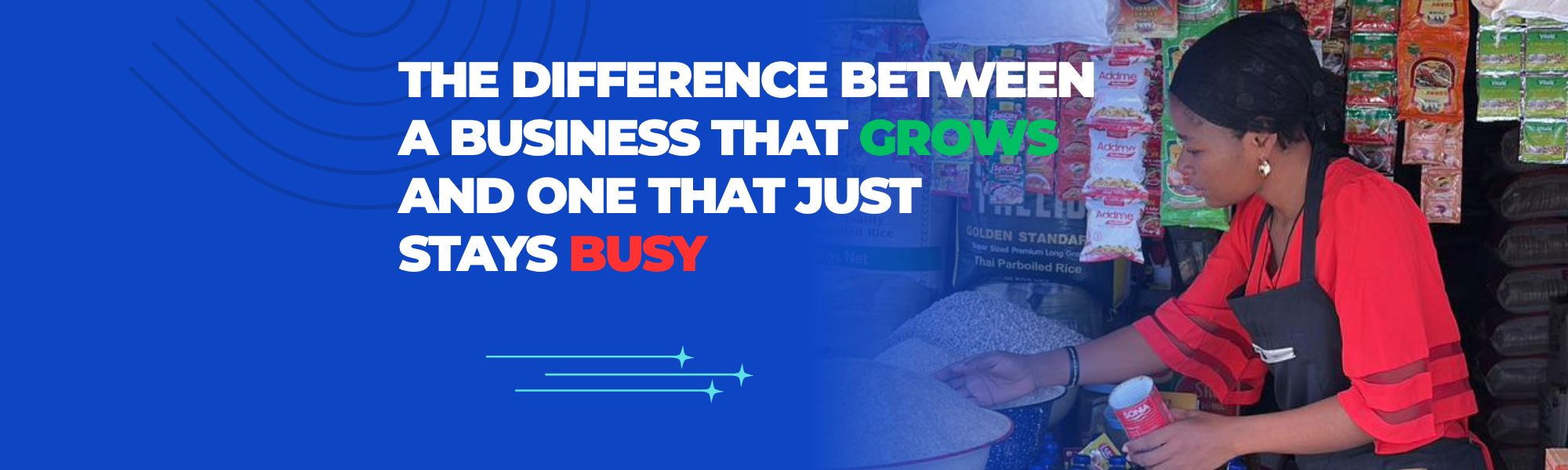
Busy Is Not the Same as Profitable
There is a belief embedded deep in Nigerian entrepreneurial culture that equates busyness with success. If you are always at the shop, always on the phone, always moving, you must be doing well. But busyness is an activity metric. Profitability is a performance metric. And confusing the two is one of the most common and most costly mistakes a business owner can make.
A business that is genuinely growing is not one where the owner is working harder every year. It is one where the systems are working harder so the owner does not have to. The distinction sounds simple. Achieving it requires a fundamental shift in how you think about your operations, particularly how you manage, track, and make decisions about your inventory.
The Hidden Cost of Running Without a System
According to a KPMG Global Supply Chain Integrity report, businesses operating without formalised inventory systems lose an average of 23% of their gross margin annually to inefficiencies they cannot see and therefore cannot fix. That figure — 23% — is not an edge case. It is the average. It means that for every ₦10 million in revenue a Nigerian business generates, ₦2.3 million is leaking through cracks in the operation before the owner even begins to calculate profit.
McKinsey research on operational efficiency in emerging market businesses identifies the same pattern: companies that invest in operational visibility, knowing what they have, where it is, and what it is doing, consistently outperform those that operate on intuition, even when the intuition-led businesses are run by more experienced founders. Experience without data is informed guessing. Data without experience is context-less numbers. The businesses that grow are the ones where both exist together.
Two Businesses, Two Realities
Let us go back to Chidi and Amaka — because their stories are not fictional. They are a composite of the real conversations happening in markets, business lounges, and WhatsApp groups across Lagos, Abuja, Onitsha, and Port Harcourt every single day.
Chidi's business looks like this:
Stock is counted manually at month-end, the first time he knows his actual position
Reorder decisions are made based on what looks low on the shelf or what his supplier is pushing
Sales are recorded in a book by whichever staff member is available
Credit given to customers is tracked in a separate notebook, or not tracked at all
His "reports" are a conversation with his accountant every 45 days
His most important business decisions are made on feeling, experience, and faith
Amaka's business looks like this:
Stock levels update automatically with every sale and every purchase received
Low stock alerts notify her before she runs out of her top 20 items
Every transaction is logged under the staff member who processed it
Customer balances are visible in real time, she knows exactly who owes what and for how long
She reviews a live dashboard every morning from her phone before she arrives at the branch
Her decisions are made on data that is never more than 24 hours old
Chidi is not less intelligent than Amaka. He is not less hardworking. He is simply operating a modern business with antique tools and the gap between them widens every month.
What Growing Businesses Do Differently
The operational behaviours that separate scaling businesses from stagnant ones cluster around a single principle: they measure before they manage. You cannot manage what you cannot see. And what most Nigerian business owners cannot see is precisely the information that matters most.
Research published in the Harvard Business Review found that companies with high inventory visibility, defined as knowing stock levels, movement rates, and valuation in real time,g achieved 2.5 times higher inventory turnover than those without it. Higher turnover means less capital trapped in stock, faster cash cycles, and more money available for growth, reinvestment, and opportunity. This is not a large-company finding. The same principle applies to a Lagos supermarket, an Abuja pharmacy, and an Onitsha wholesale outlet.
The Five Operational Habits of Businesses That Grow
Across the most consistently growing Nigerian SMEs, five operational habits appear repeatedly. These are not coincidences. They are the behaviours that a data-driven operating system makes natural, automatic, and sustainable:
1. They know their numbers daily — not monthly
Growing businesses do not wait for month-end reports. They check revenue, stock position, and outstanding debts every morning. Decisions are made on current information, not historical memory.
2. They track by product, not by total
Instead of knowing that "sales were good this week," they know that Product A sold 140 units, Product B sold 12, and Product C has not moved in 18 days. That specificity is what drives smart reordering, smart pricing, and smart promotions.
3. They hold their staff accountable through systems, not suspicion
Every transaction is tied to a specific person. Discrepancies are visible immediately. Accountability is built into the workflow, it does not depend on the owner being physically present.
4. They make reorder decisions before stockouts happen
Automated alerts notify them when stock drops below a set threshold. They reorder when they have time to negotiate, compare suppliers, and make quality decisions, not in a panic because shelves are empty and customers are asking.
5. They know their most profitable products — and focus on them
They do not treat all products equally because their data tells them which items carry the best margins, the fastest movement, and the highest customer demand. Their energy goes where the return is highest.
The Turning Point Every Busy Business Reaches
There comes a moment in every busy-but-not-growing business when the owner looks up from the grind and asks a version of the same question: "Why does it feel like I'm running faster and not getting anywhere?" That moment is not a crisis. It is an invitation — an invitation to stop adding more effort to a system that needs to be replaced, and to start building the operational infrastructure that makes growth possible without sacrificing health, time, or sanity.
The businesses that respond to that moment by building better systems become the Amakas of their industry. The ones that respond by working harder become Chidi — still busy, still respected, still going nowhere new.
Looking for a simpler way to track real-time inventory, sales management, debt visibility, staff accountability, and business reporting, AiBiz is all in one platform designed for the realities of SMEs businesses in the Nigerian market. Start your free trial today!